
Set up a learning round
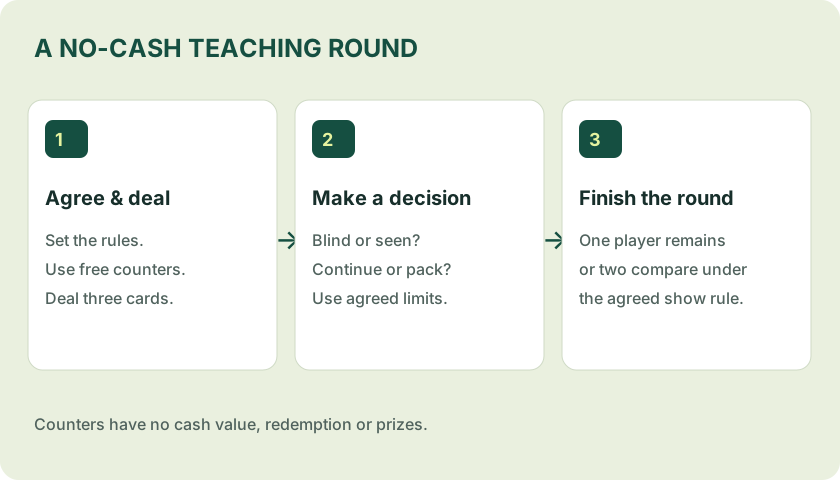
Use a standard 52-card deck without jokers for the classic format. Shuffle and deal three cards face down to each player, one at a time. Agree the rules before dealing: hand order, the position of A‑2‑3, turn order and how equal hands are resolved.
In our practice example, three adults each place one non-redeemable counter in a central pot. This initial contribution is called the boot. Counters are teaching aids only: do not buy them, redeem them or attach prizes to the result.
Know the six hand categories
In the classic high-hand format, the categories descend as follows: Trail → Pure sequence → Sequence → Colour → Pair → High card. Compare categories before individual cards. A low sequence still beats a high colour.
A‑2‑3’s position within sequences is a house-rule question. Our detailed hand-ranking chart and sequence list explain it without assuming all apps agree.
Your choices: blind, seen and pack
A blind player has not looked at their cards. A seen player has looked. Chaal usually refers to continuing play as a seen player. Pack means folding: the player leaves that round.
A common convention relates the minimum contribution of a seen player to twice that of a blind player at the current stake. Maximum increases, blind-turn limits and pot limits depend on the table. Read them rather than importing poker’s “match everyone’s bet” model.
For a no-cash lesson, use a fixed turn limit and stop after the teaching example. This keeps the focus on terms instead of escalating contributions.
Worked example with three players
- Asha, Dev and Mira each contribute one practice counter. The pot contains three counters.
- Asha stays blind and adds one counter. Dev looks, dislikes the hand and packs. Dev is out for this round.
- Mira has seen the cards and adds two counters under the example’s agreed contribution rule.
- Two players remain. Use the agreed show conditions; do not assume every table allows every player to demand a show at any time.
- Suppose Asha reveals 8♠ 8♥ 3♣ and Mira reveals K♠ J♠ 6♠. Mira’s colour outranks Asha’s pair, even though neither hand contains an ace.
If everyone except one player packs, that remaining player wins the round without needing the strongest cards. That describes the rule, not a guaranteed strategy.
Show, sideshow and equal hands
A show is the final comparison when the conditions for two remaining players are met. A sideshow is a permitted private comparison during play, subject to table rules and acceptance conditions. They are different actions.
Equal ranked cards do not automatically mean a split result. Some conventions give a tied show to the player who did not request it, while other tables specify different handling. The blind, seen and show guide lists the questions to check.
Common first-round mistakes
- Calling any three cards of one suit a pure sequence. They also need consecutive ranks.
- Comparing the highest card before checking the category.
- Treating K‑A‑2 as a valid sequence.
- Assuming the boot is the total possible contribution.
- Assuming a variant uses classic high-hand rules.
Try the no-cash hand trainer to check category recognition before reading about variants.
Sources & scope
References consulted 22 October 2026. General guidance is not a test of a specific app file.